
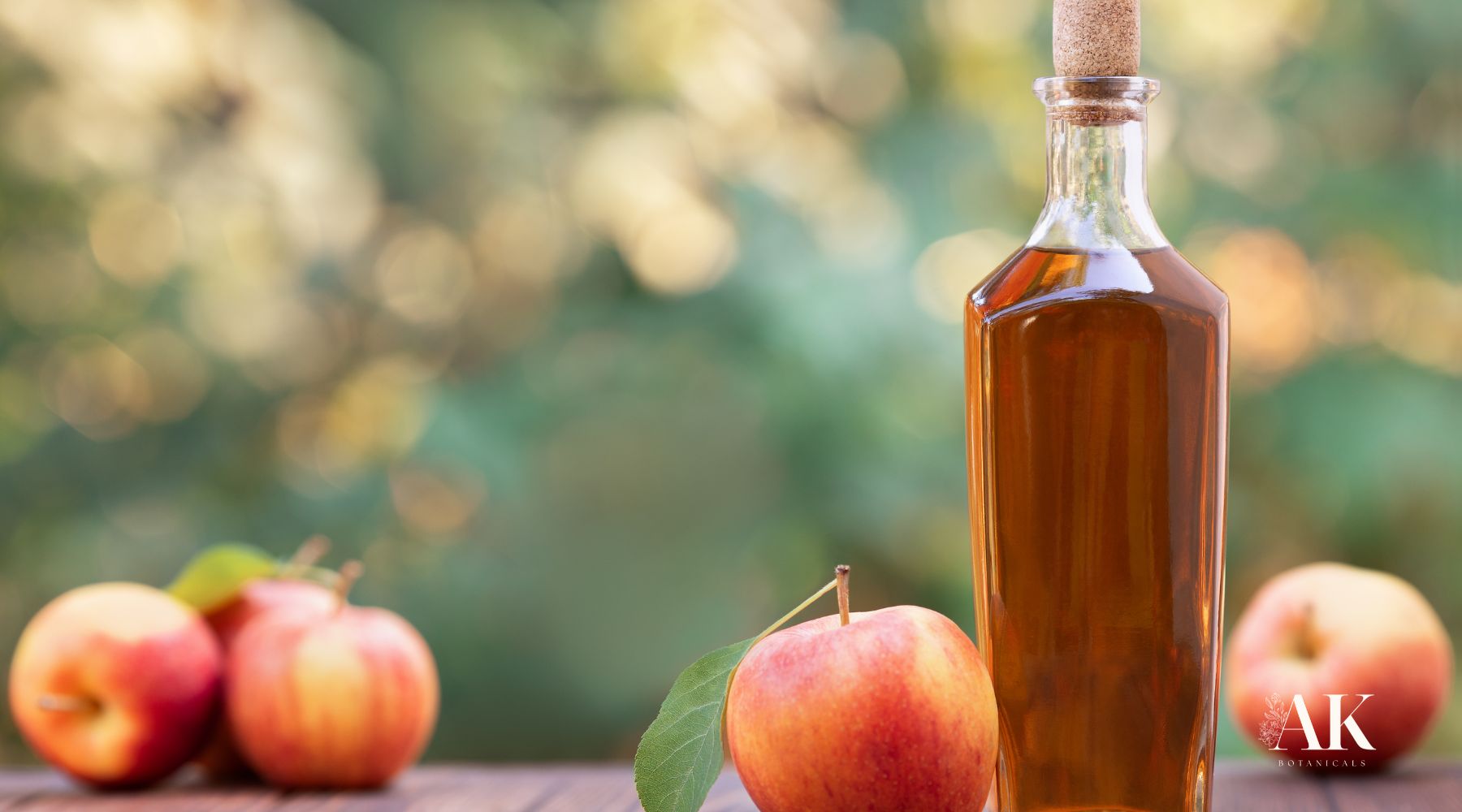
Apple Cider Vinegar for Actinic Keratosis: A Natural Approach with Caution
Apple cider vinegar (ACV) is one of the most commonly searched home remedies for rough, scaly patches caused by sun exposure — and for good reason. Its natural acidity may provide mild exfoliating action on damaged surface skin. But dermatologists consistently advise using it with caution: undiluted ACV can burn skin, results aren't guaranteed, and it should never replace professional evaluation for persistent or suspicious lesions. This guide covers what ACV can and can't do for sun-damaged skin, how to use it safely, and where it fits alongside properly formulated botanical skincare solutions like AKti-Clear.
What Is Apple Cider Vinegar?
Apple cider vinegar is made from fermented apple juice. It contains acetic acid — the compound responsible for its sharp smell and acidic properties — along with trace minerals and enzymes. In skincare, it has been used for generations as a topical exfoliant and astringent. Its acidity (pH around 2 to 3) is what gives it potential surface-level exfoliating properties on rough, dry patches of skin.
Can Apple Cider Vinegar Help with Rough Sun-Damaged Skin Patches?
Some people report that consistently applying diluted ACV to rough patches helps soften the surface, reduce flaking, and improve the appearance of the skin over time. The acetic acid in vinegar may act as a mild chemical exfoliant, encouraging the turnover of damaged surface skin cells.
However, the evidence for ACV as a targeted solution for actinic keratosis specifically is largely anecdotal. Clinical studies on ACV for AK are limited. Dermatologists including Dr. Joshua Zeichner have noted that while ACV has some benefits for skin, it can also cause significant irritation — especially if used improperly or on already-compromised sun-damaged skin.
The bottom line: ACV may offer mild supportive benefit for the appearance of rough, sun-exposed skin when used carefully and consistently. It is not a medical treatment and should not be used as a substitute for professional evaluation of any persistent, changing, or suspicious skin patch.
How to Use Apple Cider Vinegar Safely on Sun-Damaged Skin
If you choose to try ACV as part of your at-home skincare routine, these guidelines reduce the risk of irritation:
- Always dilute — mix 1 part ACV to 3 parts water. Never apply undiluted ACV directly to skin.
- Patch test first — apply the diluted solution to a small, inconspicuous area of skin and wait 24 hours before broader use.
- Apply with a cotton ball — dab gently onto the rough patch once daily.
- Do not use on broken, irritated, or open skin — ACV on compromised skin can cause chemical burns.
- Moisturize after — ACV can be drying; follow with a gentle, fragrance-free moisturizer.
- Stop if you experience burning, stinging, or increased redness — these are signs the solution is too strong or the skin is too sensitive.
The Risks of Using Apple Cider Vinegar on Skin
The risks of improper ACV use on skin are real and worth taking seriously:
- Undiluted ACV can cause chemical burns, especially on sensitive, sun-damaged, or thin skin
- Overuse can disrupt the skin's natural pH balance and damage the skin barrier
- ACV can cause hyperpigmentation in some skin types
- If a skin patch is not actinic keratosis but something more serious — basal cell carcinoma, squamous cell carcinoma, or melanoma — attempting to treat it with ACV at home could delay diagnosis and appropriate medical care
This last point is the most important. Any rough, persistent, or changing skin patch should be evaluated by a dermatologist before you begin any home treatment. ACV is not a diagnostic tool.
How ACV Compares to Other Natural Options for Sun-Damaged Skin
ACV is a general exfoliant — it acts on the surface layer of skin. It does not have a specific formulation or active botanical compound targeted at the mechanism of UV-damaged skin cells. Other natural options offer more specific properties:
- Green tea extract — antioxidant-rich, documented anti-inflammatory properties at the cellular level
- Aloe vera — soothing, hydrating, supports surface comfort
- Kanuka honey — antimicrobial and skin-soothing properties
- AKti-Clear® — a concentrated botanically-infused topical solution using Sanguinaria canadensis (Bloodroot) as its primary active, extracted via a patent-pending concentration process. One small drop applied once daily for three consecutive days per spot — a more targeted protocol than daily ACV application
AKti-Clear® is a cosmetic skincare product. It is not intended to diagnose, treat, cure, or prevent any disease. Always consult a healthcare provider regarding any persistent or suspicious skin lesions.
The Bottom Line on Apple Cider Vinegar for Sun-Damaged Skin
ACV can be a low-cost, accessible addition to a home skincare routine for people managing rough, sun-exposed skin — when used carefully, diluted properly, and with realistic expectations. It is not a replacement for professional dermatological care, and it should never be used on lesions that are bleeding, growing, or changing in appearance. For people who want a more targeted botanical approach, AKti-Clear® offers a specifically formulated concentrated option.
If you have persistent rough patches on sun-exposed areas that haven't been evaluated by a dermatologist, schedule that evaluation first. Know what you're dealing with before choosing how to address it at home.
For a complete overview of sun-damaged skin and rough patches, visit our Actinic Keratosis Guide. Browse all our educational resources at the AK Botanicals Resource Center. For common questions about AKti-Clear, see our FAQ page. Ready to try it? Shop AKti-Clear®.


%20is%20one%20of%20the%20most%20commonly%20searched%20home%20remedies%20for%20rough,%20scaly%20patches%20caused%20by%20sun%20exposure%20%E2%80%94%20and%20for%20good%20reason.%20Its%20natural%20acidity%20may%20provide%20mild%20exfoliating%20...)